Safety Concept Overview
The SD/SDV-Series is designed for integration into a complete robot system.
Safety is achieved through the interaction between:
SD/SDV-Series tool (contact detection)
Spin Bridge (safety signal interface)
Robot or PLC (safe stop function)
Safety Principle
The safety function is based on:
Contact detection in the tool
Transmission of a safety signal
Execution of a safe stop by the controller
Functional Safety Concept (ISO 13849)
The safety function consists of:
Detection of unintended contact
Transmission of a safety signal (OSSD)
Execution of a safe stop by the robot or PLC
This corresponds to a safety chain consisting of:
Input (sensor): Safety sensor integrated in the SD/SDV-Series tool
Logic: Spin Bridge safety interface (signal processing and transmission)
Output: Robot or PLC safety input and stop function
The safety signal is transmitted as dual-channel OSSD (S_a and S_b), providing redundancy and fault detection. Both channels must be active (high) to allow operation, and the safe stop itself is performed by the robot or PLC controller.
Note
The tool and Spin Bridge provide parts of the safety function but do not constitute a complete safety system. The final safety function, including the required Performance Level, must be implemented and validated by the integrator in accordance with ISO 13849-1.
Reliability Data (PFHd)
PFHd = 6.0 × 10⁻⁸ 1/h
The value applies to the safety-related parts of the tool and Spin Bridge only and does not represent the complete safety function; the overall Performance Level depends on the complete system.
System Overview
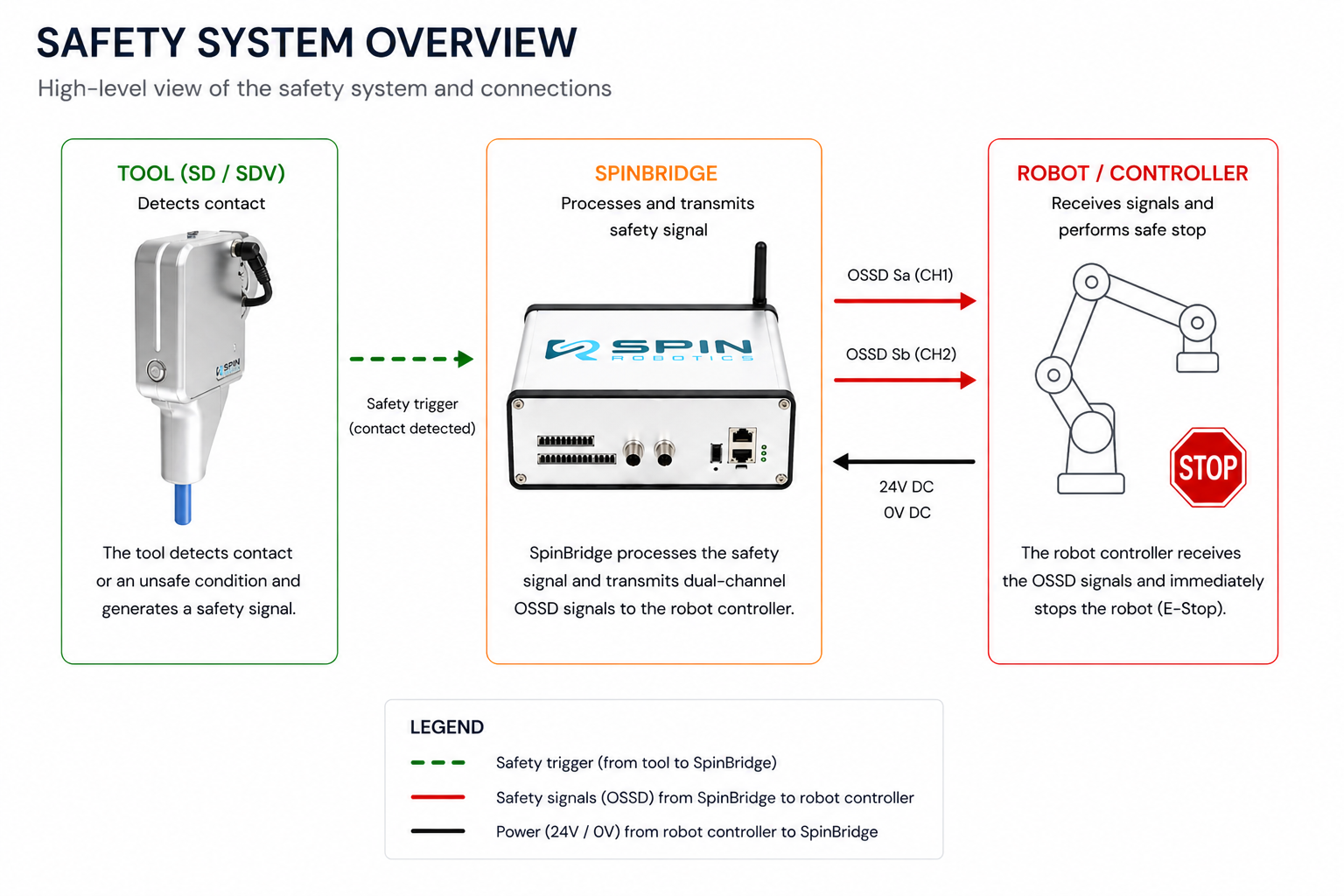
High-level overview of system components and the safety signal chain.
Further Information
Detailed information is available in the following sections: